

Your Next Website Visitor May Never Visit Your Website


You finally got the page published.
The stakeholders signed off. The links work. The headings are in place. The copy is accessible. The SEO fields are filled out. As far as your normal content checklist is concerned, the page is done.
But there is a new complication.
The person looking for that information may never actually land on the page you worked so hard to publish.
Increasingly, people are asking AI assistants a question, getting a synthesized answer, and moving on. Your content may still be doing its job, but the person consuming it may never become a traditional “website visitor.”
That changes the question content teams need to ask.
It is no longer only: Can people find this page? It is also: If an AI system uses this page to answer someone else’s question, will it understand the content the way we intended?
This is where things get challenging.
A page can look perfectly clear to the people who created it and still leave important information unstated. The main point may be buried. A section may depend on context from somewhere else on the page. A relationship that feels obvious internally may never actually be explained.
And if an AI system misses that context, the person asking the question may never know there was more to the story.
What if you could see what AI sees?
Most content teams already have tools for SEO, accessibility, analytics, and technical performance. What they often do not have is a practical way to ask: What does this page actually communicate to AI?
That was the idea behind AIRO Preview, a free, open-source Drupal module developed by Mobomo. And importantly for content editors, you do not have to leave Drupal to use it.
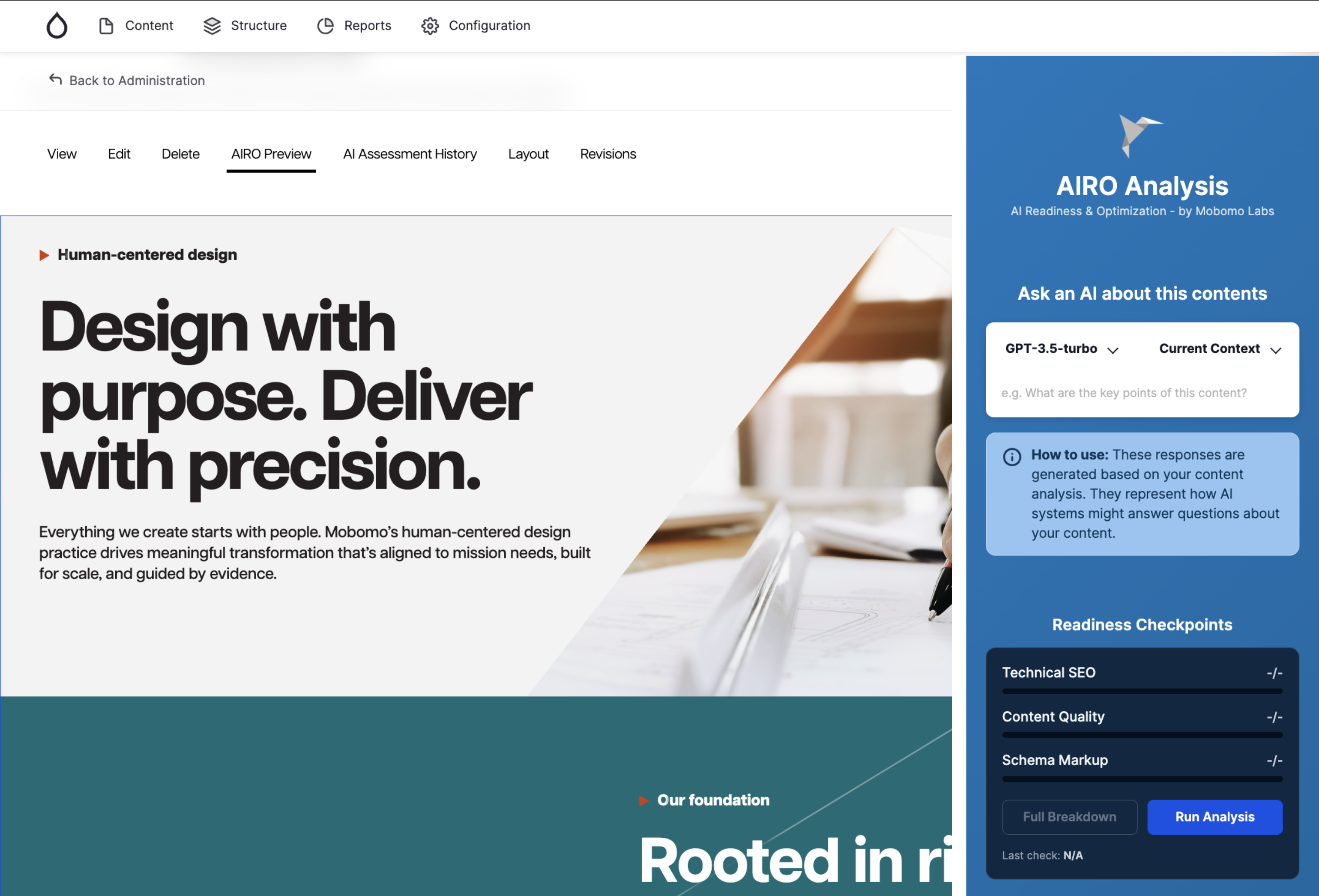
AIRO sits alongside the page you are already working on. Instead of exporting content into another application or waiting for a technical audit, you can analyze the content directly within your existing editorial workflow. Then AIRO starts turning that page into something you can act on.
Start with a baseline
Click Run Analysis, and AIRO evaluates the page across three areas: technical SEO, content quality, and schema markup. The score gives you a starting point, but the number itself is not really the point. The useful question is: Why did the page receive that score?
That is where AIRO becomes much more than another dashboard.
See what is working and what needs attention
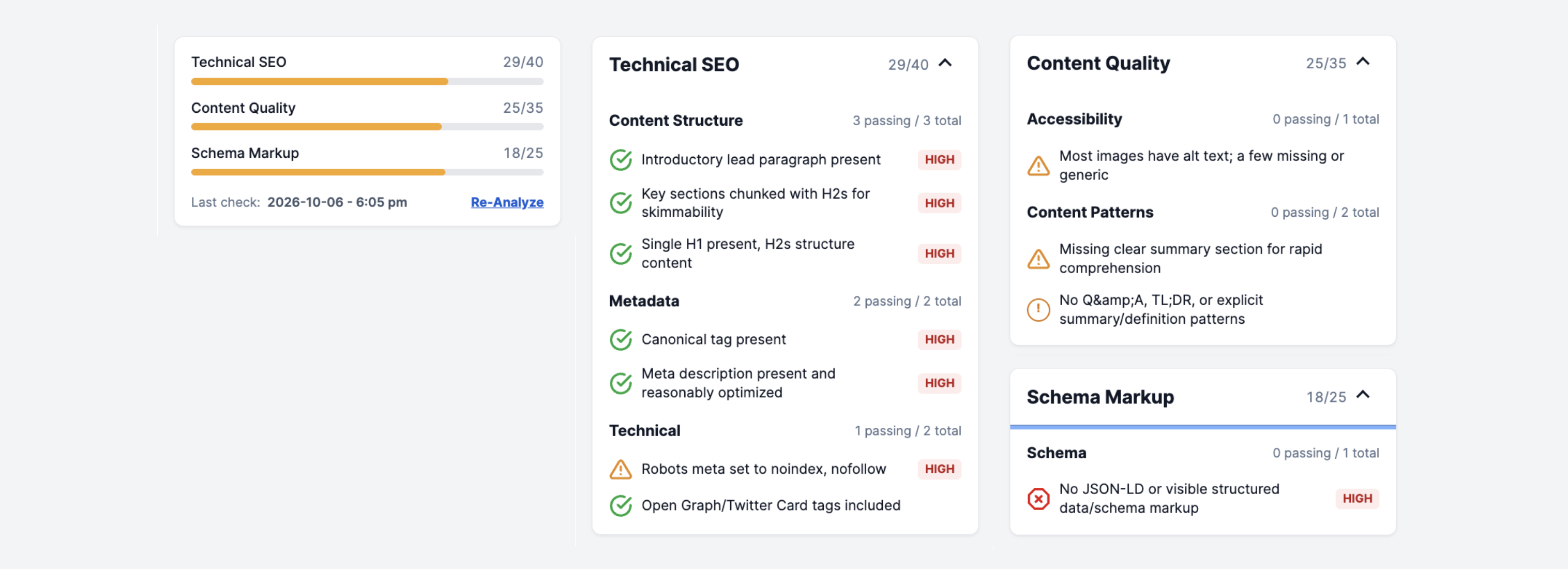
Open the full breakdown and AIRO turns the assessment into specific checkpoints.
Now an editor can see that the page has, for example, a strong heading structure and useful metadata but may be missing a clear summary, have incomplete alternative text, or lack structured data.
Those findings turn a vague instruction like “make this page more AI-ready” into something an editor can actually work with.
Review the page ➜ Identify the gap ➜ Improve the content ➜ Reassess
That creates a feedback loop instead of a one-time score. And it focuses attention on the things content teams can actually control.
Those happen to be useful questions for AI. They are also useful questions for people.
Then ask the page what it thinks it says
There is another way to test the content. Ask it. AIRO Preview allows an editor to pose a question using the current page as the source. Suppose we want to know: What UX deliverables does Mobomo produce when working on projects?
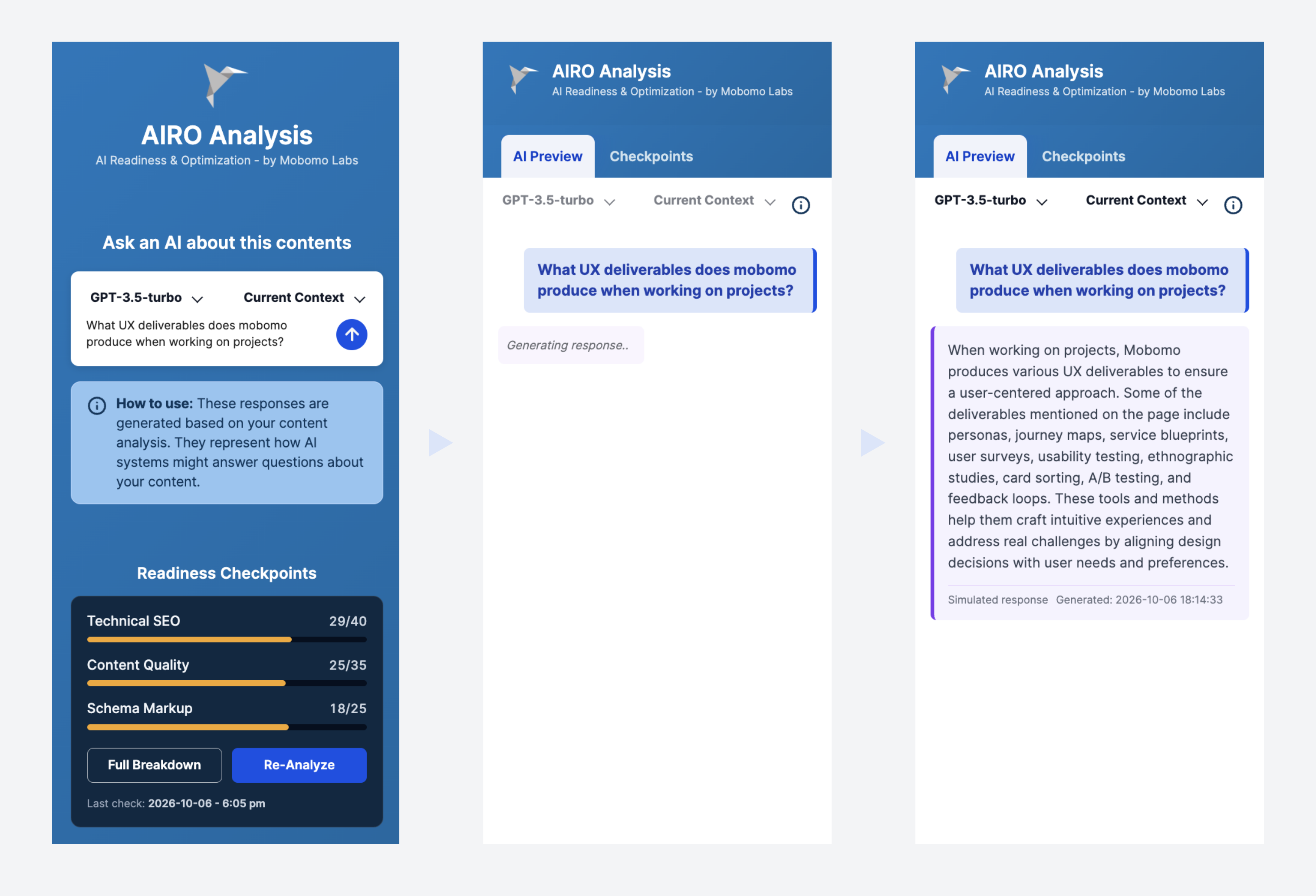
AIRO evaluates what the page actually communicates and responds from that context. Now the editor has a very different kind of feedback:
- Does the answer match what we intended to communicate?
- Did it find the information easily?
- Did it miss something important?
- Did we assume knowledge the page never actually provided?
That is the value of seeing your content through another lens. AIRO is not testing everything an AI model knows about your organization. It is helping you test what your content successfully communicates.
Better for AI should still mean better for people
The goal is not to start writing awkward content for machines. In fact, the opposite is true. Clear language, descriptive headings, complete context, accessible images, meaningful relationships, useful summaries, and direct answers make content easier for AI systems to interpret. They also make it easier for people to understand. That is why the score is not the destination.
Better content is the true value AIRO brings to your fingertips.
No tool can guarantee that a particular AI platform will cite your page or use it in an answer. But content teams can control whether the information they publish is clear, structured, complete, and useful.
AIRO Preview delivers a practical way to see those qualities differently without leaving the Drupal environment where the work is already happening.
If you’re reading this and thinking, “We need this,” AIRO Preview is free and open source. Share Mobomo’s companion developer article, Inside AIRO: Building an Extensible AI Content Audit Framework for Drupal - Mobomo, with the person who manages your Drupal site so your team can evaluate whether it fits your environment.